


 Home Home  Cactus League Cactus League  Grapefruit League Grapefruit League  Schedules Schedules  Guide Guide  Contact Us Contact Us |
| Spring Training Practice Viewing and Autograph Getting Guide |
| by Graham Knight |  Send this page to a friend Send this page to a friend |
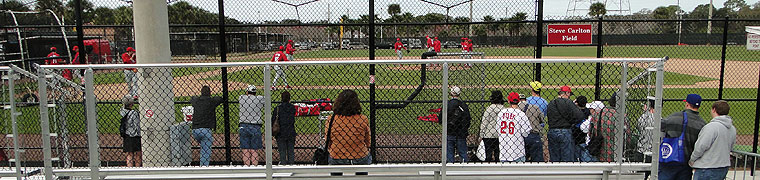
A typical scene during the February practice only portion of spring training. This one is from the Phillies' complex in Clearwater.
Around mid-February of every year the words baseball fans long to hear - pitchers and catchers have reported - are pronounced in the various outlets that cover America's pastime.
Between teams’ various reporting dates and the day a little less than two weeks later when spring training games begin, players practice on the back fields (in most cases) of the sprawling complexes that are adjacent to or near the stadium in which they play those games.
While the process of attending spring training games is well documented, information is scarce – to the point of being non-existent – about watching spring training practices.
But if that’s the information you seek, then you’ve found the right article as the written words that follow detail what you need to know in order to pass the time watching America's pastime in its most pastoral of settings.
Non-game day practices in February are one of the best parts about spring training. Crowds are pretty sparse, and you can get very up close to what's going on. That proximity is the allure to most fans, while the ease of obtaining autographs satisfies many others. All enjoy the cost associated with the access. There is none.
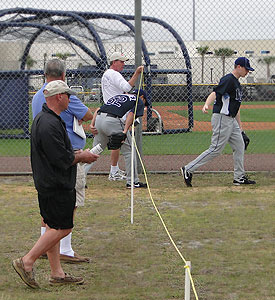 The epitome of intimacy: Rays fans help out Rays players during a practice in Port Charlotte. |
For certain, the free to see practices don’t draw many fans or much media attention, so attendees get an often unobstructed and unfiltered look at how players prepare and coaches coach. Conversions can be heard while practice is observed from behind a simple chain link fence, and it’s not uncommon in some places for players to frequent the common areas in which fans congregate.
It’s during this time that baseball feels more little league than big league, the players more human than heroes. And then March rolls around, games begin, masses ascend to watch them and most of the intimacy that early arrivals enjoy is gone or severely restricted.
But before than happens, for about three hours per day for nearly two weeks fans can enjoy baseball nirvana.
Beginning with the day of the first workout for pitchers and catchers and ending when a team plays its first Cactus or Grapefruit League game, teams hold daily practices at their spring training complex. Or at least their portion of the complex for the 14 teams that share one.
Practices generally start in the morning, in the 9 to 10 a.m. range, and are done circa lunch (Noon to 1:00). If it's action you seek, it's better to be there early than late, as more visible practicing, drills and instruction takes place in the morning than early afternoon. On the other hand, autograph seekers will have their most success as players depart the practice fields for their clubhouse or the often off-limits batting cages.
Technically, when practices start is manager driven, but it almost always falls within the same morning timeframe mentioned in the previous paragraph with the only possible exception being the first day workout, which is sometimes held in the afternoon following the inaugural team meeting and/or physicals. But other than that, practices begin in the morning, and they are held daily, so that means there are workouts on the weekends.
Basically, there's no discerning between a Tuesday and Saturday in the spring training baseball workplace, other than it stands to reason that slightly more folks can be expected to watch teams practice on weekends than during the week. But rarely are numbers larger than the hundreds for any day, and it's not uncommon for some teams to practice in front of "crowds" of less than 100.
As previously mentioned, no admission is charged, nor is a ticket of any sort required to attend a practice session.
Pitchers and catchers report to spring training anywhere between 3 to 7 days prior to the rest of the team, but despite their formal reporting date many position players will be there and practicing with the pitchers and catchers when they begin their workouts. So, for example, if you're a Mets fan don't be surprised to see a guy like David Wright in camp from the get-go. Plus, position players who had something fixed surgically during the off-season are often at camp well before they have to be.
While players often start arriving many days, or even weeks, before the officially sanctioned MLB reporting dates, spring training complexes adhere to those dates for public access. So arriving prior to any team’s pitchers and catchers first workout date is pointless, unless you want to stand behind a fence and gaze from a distance somewhere.
Now that you know when to be there, it’s important to know where you need to be. Despite what many people believe, the stadiums where games are played are rarely used by the teams during February training. Here’s a team-by-team breakdown of where practices are actually held:
CACTUS LEAGUE
Angels, (Tempe)
A's, (Mesa)
The A's took over the Cubs' old (and since renovated) training grounds in Mesa in 2015, so 2020 will be the team's sixth year of holding practices at Fitch Park, which is a half-mile south of Hohokam Stadium. Fitch Park has four fields that are fan accessible and a medium-sized parking lot is near the complex's gate, which is usually unlocked around 8 a.m.
Brewers, (Maryvale)
The Brewers have a four-and-a-half field training complex directly behind their ballpark in the western Phoenix neighborhood of Maryvale. Plenty of paved parking is next to the team's practice facilities, which fans can wander through well before practice begins.
Cubs, (Mesa)
The Cubs were a 2014 beneficiary of a new spring training stadium and complex, and the practice fields and Sloan Park are adjacent to each other. The complex features six full-sized practice fields plus a half-field for use by Mesa's beloved Cubs. As for when they're used in February, the team states that although practice times can vary, "they often begin at 9 a.m. and run until approximately 12:30 p.m."
Diamondbacks, (Scottsdale)
The Diamondbacks' digs on the Salt River Pima-Maricopa Indian Community reservation on the absolute edge of Scottsdale's city limits contain six full and two half fields for their training usage. All fields are adjacent to the complex's stadium, beginning behind the third base grandstand and spanning beyond left field, and are to be accessible starting at 9 a.m.
Dodgers, (Glendale)
The Dodgers practice on the eastern side of Camelback Ranch, where they have six fields at their disposal. Fans can start flocking to them when the complex's gates open at 9:00 a.m. and they should park in the lot that is a short distance from the intersection of 107th Avenue and Camelback Road.
Giants, (Scottsdale)
The 2014 world champions practice in Scottsdale Stadium and on the single practice field that is adjacent to it. The practice field is tucked away in the right field corner but has no direct access for fans wanting to watch workouts there. What fans can glimpse is seen through the black wrought iron fence along the practice field's left field line. Watching practice on the main field is as simple as sitting wherever you desire in the 8,188-seat grandstand. Stadium gates open around 10 a.m. on practice days. The best place to park is in the free public garage found directly behind Scottsdale Stadium's left field.
Indians, (Goodyear)
The Indians practice on six of the fields found within the Goodyear Recreational Complex that are in the shadows of the city's general aviation airport. The training complex is not next door to the ballpark, but it's not too far - maybe a 10-minute walk - from it. It's actual address is 2601 S. Wood Blvd. and parking spaces are found along both sides of Wood Blvd. The chain link fence gate to the complex swings open at 9:15 a.m.
Mariners, (Peoria)
The Mariners are allotted six full-sized practice fields within the Peoria Sports Complex. Small sets of bleachers are set up at each of them. The fields are alongside the stadium's west parking lot, best entered by turning onto Mariners Way from 83rd Avenue, and beyond the stadium's first base grandstand. Practice field gates open at 9:15 a.m.
Padres, (Peoria)
All practice fields at the Peoria Sports Complex used by the Padres are found beyond the stadium's right field. The gate to them opens at 9:15 a.m. Park your car in the stadium's east lot, which is entered from Paradise Lane. Workouts at each of the Padres-assigned six big fields can be enjoyed from the comfort of uncovered bleachers.
Rangers, (Surprise)
The Rangers practice on six fields that are behind the first base side of their spring training stadium. Fans are allowed into the Rangers' half of the Surprise complex at 9:30 a.m. and for easiest access they should park in the lot near the intersections of Bullard Avenue and Tierra Buena Lane.
Reds, (Goodyear)
The Reds practice on six fields in their portion of the Goodyear Recreational Complex, which is found near the intersection of Wood Boulevard and Estrella Parkway. It's a fairly long walk from Goodyear Ballpark to where the Reds do their training so it's advisable to park in the spaces that are on either side of Wood Blvd. Fans are permitted entrance into the Reds practice area beginning at 9:15 a.m.
Rockies, (Scottsdale)
Same as their complex mates, the Rockies get use of six full and two half fields at the still pretty new Salt River Fields complex that is basically inches east of Scottsdale city limits. The bulk of those fields are behind the main stadium's first base grandstand. All fields will be accessible to fans beginning at 9 a.m.
Royals, (Surprise)
The Royals practice behind Surprise Stadium on six fields that are parallel to the stadium's third base side. Their location is convenient to the stadium's main parking lot, from which it's a short walk to the practice field gate that opens at 9:30 a.m.
White Sox, (Glendale)
The White Sox practice on six fields that can be seen from Camelback Road. Found on the western half of the Camelback Ranch complex, fans have easy access to them beginning at 9:00 a.m. Visitors should park in the west gate lot, accessed via 111th Avenue (aka Ballpark Boulevard).
GRAPEFRUIT LEAGUE
Astros, (West Palm Beach)
The Astros practice on the fields in the northern half of the Ballpark of the Palm Beaches complex, which means their six full-sized practice fields are found beyond the outfield of the stadium and are spread out near where 45th Street and Military Trail intersect. Fans use the main entrance for the ballpark, which is found on Haverhill Road, to access the parking lot that is adjacent to the Astros' fields.
Blue Jays, (Dunedin)
The Blue Jays hold their workouts 3½ miles northeast of their spring training stadium at the Cecil P. Englebert Recreational Complex, which is in a residential area of Dunedin and contains five practice fields. The address for the complex is 1700 Solon Avenue, although that's not where you will find public parking. Instead drive to the nearby Louis A. Vanech Recreation Complex at 3051 Garrison Road. Upon entering the Vanech Complex take its asphalt path until it dead ends after about a quarter mile at a small parking lot that's near the Blue Jays' practice field gate.
Braves, (North Port)
The Braves' practice fields are very close to CoolToday Park. The same parking lot is used to access both the ballpark and training complex, which has six full-sized fields and a half-field.
However, at least in their inaugural season at the complex, the Braves only allow fans access to the stadium, where the team holds some practice and the gate opening time is 9:00. So the only place from which Braves' practices can be watched in February is CoolToday Park, as the back fields don't open to the public until March 1.
Cardinals, (Jupiter)
The Cardinals practice in the array of fields beyond Roger Dean Stadium's outfield. Specifically, their half-dozen practice fields lay behind the Cardinals clubhouse that spans the stadium's right-center field fence. Fan access to them is just past the parking lot that is behind the clubhouse, where a narrow paved path off of University Boulevard leads to the main practice field entrance gate.
Marlins, (Jupiter)
The Marlins practice on six fields that begin beyond their clubhouse that is behind the left-center field fence at Roger Dean Stadium. The main fan entrance to the Marlins' complex is adjacent to Field #4 on the portion of Stadium Drive that is a little ways beyond the stadium's grass field parking lot.
Mets, (Port St. Lucie)
The Mets practice on the fields that are adjacent to Clover Park, which is where fans can park. Their practice complex is centered behind the ballpark's left field fence. Gates to it open each morning at 9:30.
Nationals, (West Palm Beach)
The Nationals utilize practice fields that are found in the southeastern side of their West Palm Beach-based complex, which they share with the Astros. The fields the Nats workout on overlook the ballpark's first base/right field side and the spectator parking lot for them is entered from Military Trail.
Orioles, (Sarasota)
The four fields beyond the outfield wall of Ed Smith Stadium are where you'll find the Orioles for most of February. Those practice fields are accessible from the parking lot that is behind the stadium's left field foul pole. The complex's chain link fence gate rolls open at about 9:00 a.m. although practices don't start until a little later (a range of 9:30 to 10).
Phillies, (Clearwater)
The Phillies practice at the Carpenter Complex, a four-field facility that is adjacent to their spring training stadium and at which public parking is available.
Pirates, (Bradenton)
The Pirates practice further away from their spring training stadium than any other team, but the distance from McKechnie Field (now called LECOM Park) to their Pirate City training complex is just five miles. For those with a GPS, Pirate City's Bradenton address is 1701 27th Street East. Parking at Pirate City is in the paved lot that's shared with the neighboring River Run Golf Links. Fans can park so close to the entrance gate of the four-field baseball facility that some vehicles end up in harm's way (home run ball landing territory).
Rays, (Port Charlotte)
The Rays practice on the five and a half fields that are behind the Charlotte Sports Park outfield. Generally the gates to the back fields open between 9:00 and 9:20 a.m. but never before the Rays are already on the fields. That aside, this is an exceptionally fan-friendly facility, with minimal restrictions and plenty of player-fan interaction. The only area off-limits are the bullpen mounds.
Red Sox, (Fort Myers)
The Red Sox debuted both a new stadium and practice complex in 2012 and they are contained at one site, unlike in the past. The team's Player Development Complex, highlighted by six full-sized practice fields, is just beyond the Green Monster of the 10,823-seat JetBlue Park. Plenty of public parking is available within the 106-acre "Fenway South" complex, whereas none was available at the place where the Sox trained from 1993 through 2011. As for when fans are allowed access to the daily proceedings, the gate opens at 9:00 a.m.
Tigers, (Lakeland)
The Tigers practice in their aptly named Tigertown complex, which sprawls from behind one end of Joker Marchant Stadium's outfield to the other. The practice complex has six fields, with the one named in honor of Hank Greenberg close to the Tigertown entrance gate. That black wrought iron gate is just beyond the Tigers clubhouse, which is situated down the right field line of the stadium. Lots of parking spaces are available near the practice field gate. Additionally, fans can watch Tiger workouts from outside of the complex by standing behind the outfield fences of practice fields #2 and #3. Those wanting to do that can park behind the Field #3 batter's eye in an area that is easy to find from Granada Street.
Twins, (Fort Myers)
The 80-acre CenturyLink Sports Complex contains Hammond Stadium and all of the Twins' practice fields. Three and a half fields are at the far end of the complex while another full-sized practice field (with covered bleachers) is in the shadow of the stadium's third base side grandstand. The Twins use all of the fields, and often practice on the playing field in the stadium too. Plenty of parking is available for all of the facilities in the grass fields that span from the stadium to the back fields.
Yankees, (Tampa)
The Yankees do all of their open to the public practicing at Steinbrenner Field and/or on the practice field that's aside the stadium, which has enough parking spaces (800) to handle most or all, depending on the day, of the crowds that wish to watch the Yankees practice in George Steinbrenner's adopted hometown. And, as of 2018, it is the Yankees' intention for practices to be "generally held from 11:00 a.m. - 2:00 p.m."
Everything changes come March, when teams mostly practice in their stadium prior to games, although some drills or batting practice often takes place on the field adjacent or closest to the stadium. But the experience then is as different as the size of the gatherings are to watch them.
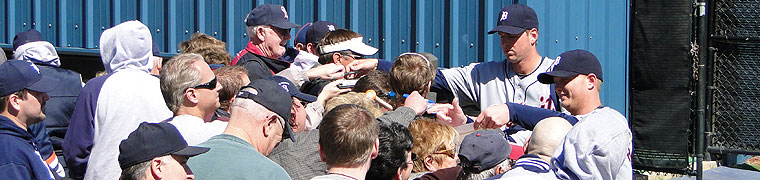
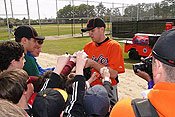
These fans in Lakeland are doing what many consider to be the best part of their spring training experience: getting autographs.
AUTOGRAPHS
As anybody who has ever been will tell you, there's no better place to amass autographs than at a spring training complex in February. Often the game plan for acquiring them is as simple as showing up with a Sharpie and bringing plenty of things to sign. Additionally, players and coaches are often happy to pose for pictures.
That said, there are some general guidelines for fans to follow. Given that the atmosphere is relaxed and their days more carefree than they will be, players of all caliber are more apt to sign, and keep on signing, for the dozens to hundreds of fans that come out to see them, realizing that’s why a high percentage of people that are there are actually there.
But the players do have a job to do and they are especially focused on preparing to do that job in the morning. So stretching takes precedence over autographing for the majority of players at the beginning of practice. There may be some limited exceptions, but the guys doing the signing in the morning are often the old-timers that are in camp as special instructors. A prime example is Al Kaline at Lakeland’s Tigertown.
For modern day players, most don’t start signing en masse until their day’s work is done. Or at least until their visible to the fans work is done, as plenty hit in indoor cages after they’ve left the outdoor practice fields behind.
Before they head to the clubhouse or the cages, many players head over to whatever barrier separates the fans from them. If you just figure out where the clubhouse is, then you are sure to flag down many players on their way to it, if they don’t find you first. Generally speaking, look for the biggest throngs of fans and that’s the likely autograph spot of choice for players.
As the cliché goes, "players may sign autographs or interact with fans at their own discretion, however please be respectful to players and other fans."
Those are the exact words printed on a sign outside of the Rays' practice field complex in Port Charlotte, but are the mantra in each of the 30 camps that are split evenly between Arizona and Florida.
So don’t push, don’t shove, or do anything to cause a ruckus and give players a reason to avoid a “situation” and you’ll get a bunch of autographs.
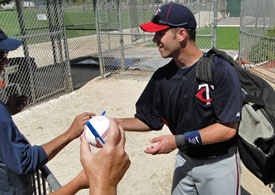 Even superstars participate in the annual "write" of spring. |
As for who signs, that's a daily guessing game and part of the fun. Yes, a whole lot of no name on their back non-roster invitees sign, but so do the superstars like Mike Trout and Miguel Cabrera. The only thing that is certain is that getting signatures is much easier at a complex than at any stadium players will frequent from about February 22nd forward.
Graham Knight has gone to see spring training in Florida 16 times and has made 7 visits to Arizona for the same baseball watching purpose. He has seen multiple games in every spring training ballpark and has visited the practice complexes for each team. In 2010, he first witnessed the practice-only portion of spring training in Florida. The next year he watched some full squad workouts and scrimmages in Arizona, and has done the same thing in more recent years. This spring he'll be back to see some more activities on the back fields...and eventually games on the main field.